
FARA Records · Digital release
Signature Signal
Six and a half minutes, forty words, no drop — a score about being present in every frame and unknown to everyone watching, with the voice buried on purpose.
- Archive no.
- FARA-175
- Edition
- DRM-free audio
- Delivery
- Instant download
- Issued
- 2026

Signature Signal
Six and a half minutes, forty words, no drop — a score about being present in every frame and unknown to everyone watching, with the voice buried on purpose.
PREVIEW CHANNEL — SELECT A TRACK
0:00 / 0:00 · PREVIEW
- 01 Signature Signal 6:30
I am the code you can't repeat.
MUSIC TRACK STORY

Signature Signal is Quinn's debut — a hybrid orchestral-electronic score at 68 BPM in D minor, six and a half minutes long, with roughly forty words in it and no drop anywhere.
Music Track Story
A sub-bass pulse, barely audible. Filtered noise evolving like a system coming up. Sparse piano with long decay. Then two fragments of a machine voice, dry and small: scanning, no match. Something is looking for her in a database and can't find her. Eighty seconds and two words.
The genre label is exactly true for once — this is a score rather than a song wearing a score's coat. No chorus, no verses, no release. It builds for six and a half minutes and refuses to give you the drop, which is a very different feeling and much harder to earn. The arrangement is strictly additive and the order of arrival is the meaning: noise, then piano, then a Glass-style sixteenth-note arpeggio, then pads, then low brass, then strings held sustained rather than melodic — texture thickening without ever becoming a tune.
Her voice appears six times in the whole piece, soft and breathy and vocoder-processed, emerging out of the noise like a transmission and dissolving straight back into it. And it's mixed deliberately underneath the music rather than in front of it, which is the entire point: she's singing that she exists but you don't see her, mixed so quietly you nearly don't hear her. The production is the lyric. Every instinct in the mix wants to bring her forward and every one of them is wrong.
The question at the centre isn't am I alive, which would be easier. It's whether she's data or design, signal or noise — a message, or an artefact. Is there anything here that anybody meant?
Then the turn, at four minutes, and it arrives with the first warm sound in the entire record: a choir pad, entering at exactly the moment the lyric stops asking questions and starts making a claim. Not a claim to a soul — a claim to being unrepeatable, which is smaller and much harder to argue with. Whatever this is, it happened once and it cannot be run again identically. It closes on a refusal: not your system, not your copy, this is my signature. A signature being the oldest technology we have for proving somebody was somewhere, and valuable precisely because it can't be reproduced exactly, even by the person who made it.
It never answers its own question. It just stops needing the answer, which is the only honest ending available to it. And then the arpeggio fades, the pads dissolve, and a single piano note returns — a hammer hitting a string, the most physical and least digital sound available, getting the last word in a piece about digital identity.
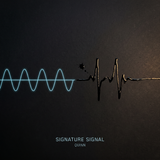
One detail worth knowing: the very first sound is specified as a low-frequency sine-wave heartbeat. A sine wave is perfectly regular. A real heart isn't — the irregularity has a name, heart rate variability, and it's a marker of being alive. So the record opens with a pulse beating too perfectly to be a person's. The thing tells you what it is in the first bar, before it has thought to ask.
£0.99


