
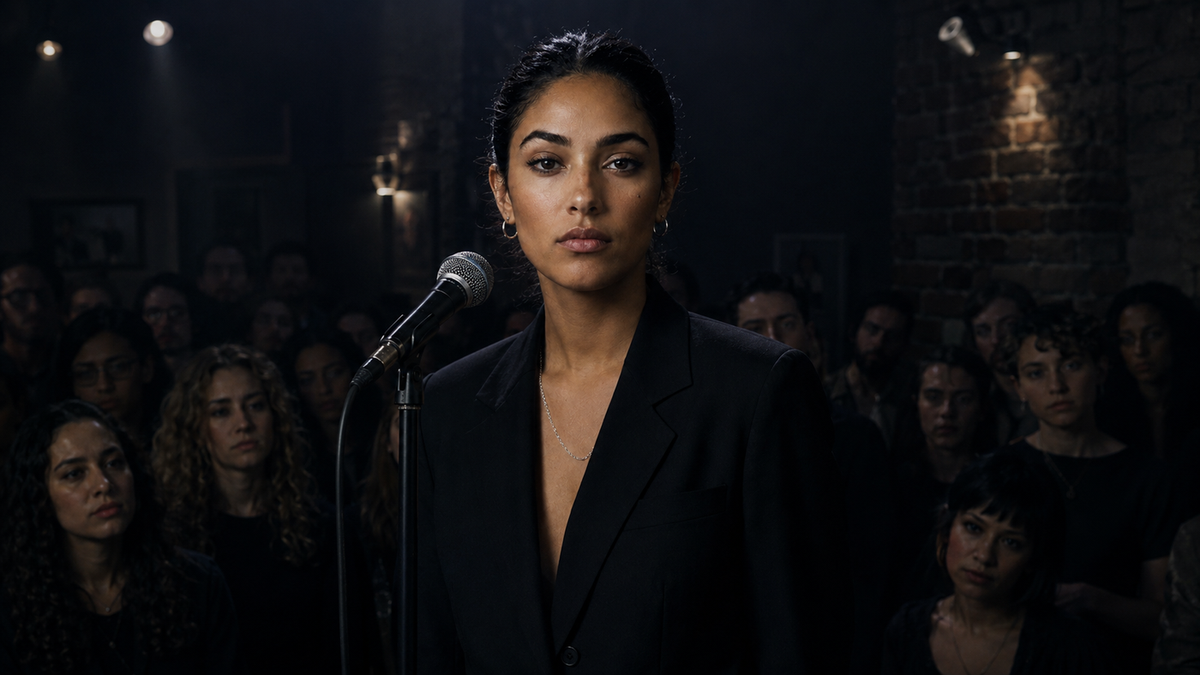
On Don't Walk Away Yet (Upgrade), sub bass carries the weight while two close voices hold their ground. The 108 BPM arrangement makes a small hesitation feel charged. ADAH's minimal house and dark electro draw on a Washington Heights childhood full of salsa, freestyle, merengue and house; her own voice leaves more space. Here, subtraction becomes a way of deciding how close another person can get.
Another person makes every pause an answer.
ADAH
What do you listen for before you write a word?
ADAH: Where the next breath wants to go. I can have a lovely sentence and nowhere honest to put it. Then it's a lovely sentence for somewhere else. I map the pauses first. A line has to leave the room in a better state than it found it. Sometimes the best thing I wrote that day is the thing I took out.
Your childhood soundtrack sounds much louder than that.
ADAH: It was music coming through doors, people cooking, somebody turning something up in another room. Salsa didn't wait politely for house to finish. I think that taught me to hear movement before category. The quieter part came from finding my own place inside all that sound. You don't have to compete with every room you grew up in.

Why put such a close voice against so much empty space?
ADAH: Because distance changes the sentence. A little reverb can make somebody sound as if they're already remembering what happened. I like the moment before that. Close enough that a small hesitation matters. A soft guide vocal is useful for that too: if the timing is wrong, there is nowhere for it to hide behind volume.
What does KOSTA change in the picture?
ADAH: Another person makes every pause an answer. Alone, you can keep deciding what a silence means. With two voices, somebody has already put something into it. I like that the balance can move without either person announcing it. One line sounds like a command; a later line makes you reconsider who was actually choosing. You have to leave space for that turn.
How do you keep a repeating hook alive?
ADAH: I don't ask it to become bigger every time. The same words can return with a different weight because of what just happened around them. A loop can keep a question open. If you decorate every return, eventually the decoration starts answering for you. I'd rather the listener notice one tiny shift than be instructed to feel a huge one.
The record stops instead of fading. Why leave it there?
ADAH: A fade gives everyone time to get comfortable with leaving. The hard stop keeps the room unfinished. You still have the last phrase in your body, then there's nothing underneath it. I like an ending that makes you sit with what was said, instead of putting a gentle hand on your shoulder and walking you out.
What should somebody follow on the second listen?
ADAH: Follow the gap between the voices. Then follow the bass. They are doing different jobs, and neither needs much explanation. You might hear the song as tenderness one day and stubbornness another. I'm happy for that to change. I want to make something precise enough to hold you, with enough room left for whatever you bring.
Start here
Hear Don't Walk Away Yet (Upgrade), explore ADAH's records, or read the ADAH Wiki.

