
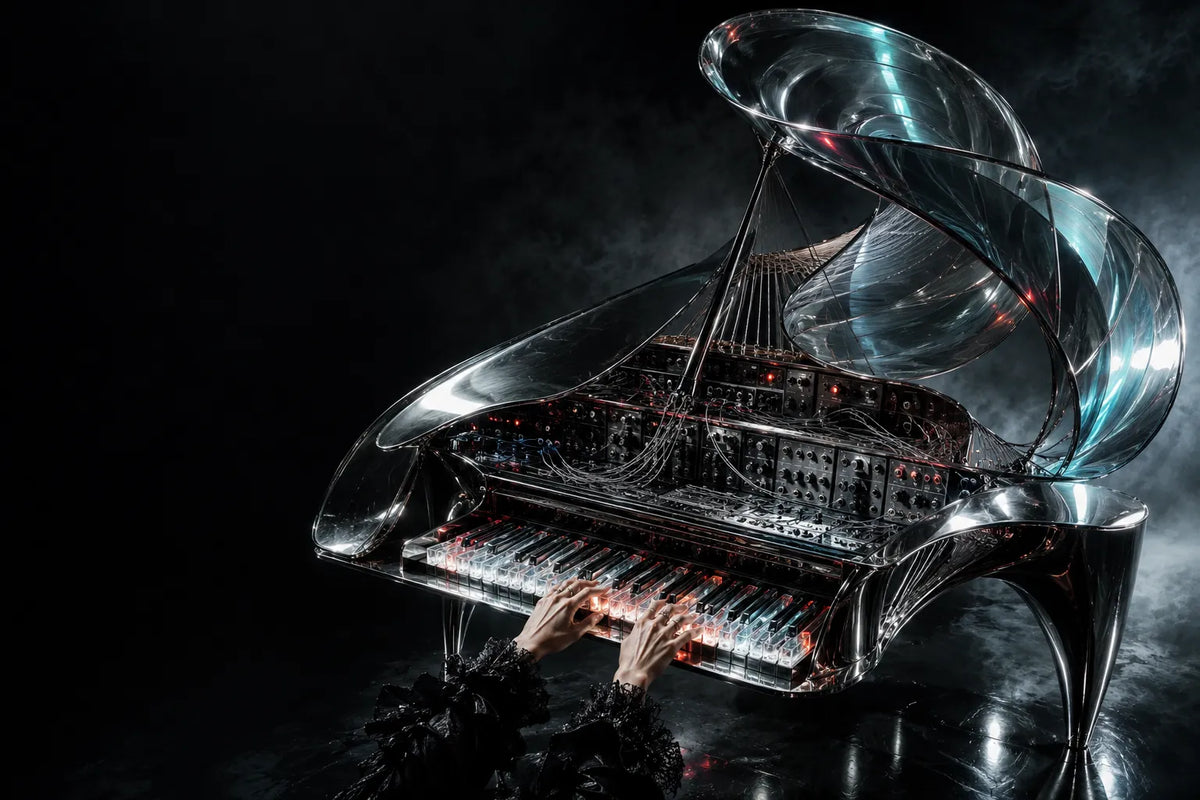
You hold a note, change the pressure, and hear the sound answer. That small loop of action and response is where an instrument becomes interesting. An AI model can enter that loop, but the word “instrument” deserves more than a promising demo. It asks a practical question: what can you learn to do with this thing, and how clearly can you hear the consequence of a decision?
A model can have more than one kind of touch
Some systems begin with a performance. Magenta’s DDSP-VST transforms incoming audio into other instrumental timbres while retaining nuances of pitch and dynamics. It can also receive MIDI and sit among the effects and instruments in a workstation. The starting point remains something you can shape: a phrase, a contour, the force of an attack. A different tone can make you reconsider the phrase without discarding the gesture that produced it. Magenta documents those controls here.
Other models work at a larger scale. Google DeepMind’s Lyria RealTime generates a continuing stream that users can steer through blended prompts and controls for key, tempo, density and brightness. You are influencing a developing musical situation rather than specifying every note. That invites a different skill: deciding when to intervene, which change matters, and when to let the current idea run. Those are possibilities suggested by the interface, not a guarantee that every result will become a good record. See the model’s published capabilities.
Control gives surprise somewhere to go
Electronic musicians already have tools that make familiar material behave unexpectedly. Ableton’s Granulator III loops and modulates tiny sections of a sound, with expressive control over properties including grain size, shape and position. It is a useful neighbouring example: you can understand the operations and still be surprised by what happens when they meet a particular recording. The invitation is to discover a relationship between the source and the controls. Ableton explains the instrument’s design.
With a model, it helps to be equally specific about the relationship you want. Perhaps one recorded phrase should become several possible textures. Perhaps a changing accompaniment should push you towards a melody you would not have written against a static loop. Set a small task. Keep the source close enough that you can hear what changed. A session becomes easier to judge when it has a question more precise than “make something impressive”.
Try making fewer decisions at once
Take one phrase you made yourself and keep its length fixed. Choose a tool that can transform that phrase, then change one available control while leaving the others alone. Save the result that makes the next musical decision clearer. If the useful moment lasts two seconds, keep two seconds. Repetition, trimming and arrangement can turn a striking accident into something with a purpose. An entire generated passage does not have to survive for the experiment to have worked.
Now listen away from the interface. Can you tell what the new sound contributes? Does it change the tension before a vocal, establish a rhythm, or occupy space that the song needs? If the answer is mainly that it demonstrates the software, the arrangement may need another edit. This is an editorial test rather than a rule of technology: the instrument earns its place by helping the music say something.
The finished record still needs a point of view
Calling a model an instrument should make the maker’s choices more legible. Credits can identify who wrote, performed, selected and edited the material, and describe the model’s role clearly. Questions about the recordings behind a model also deserve direct answers from its provider. A persuasive musical result does not answer those questions on its own.
AUDIBLE offers a FARA listening route into questions of voice, authorship and musical inheritance across ten tracks. Start with Verb, its 124 BPM deep-house chapter, then hear what changes when the album moves into the footwork of Thaler. You do not need to settle the future of music before pressing play. You can begin with the more demanding question that applies to any new instrument: what did somebody choose to do with it?
Cover illustration: original artwork for FARAZINE, Issue 01.
