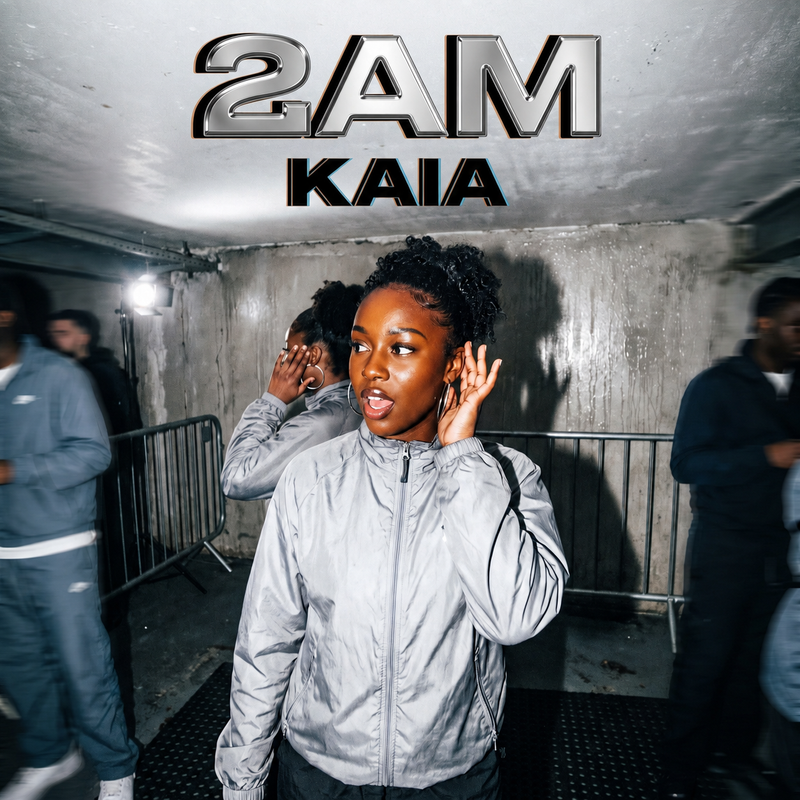
Kaia
Thamesmead, South East London — now based in Woolwich · FARA Records
Full Bio / WikiKaia (Kaia Mensah-Boyd, b. 28 January 2002) grew up eleven floors above Thamesmead, close enough to the river that the Thames Barrier sat in the kitchen window like a row of speakers pointed out to sea. Her mother worked nights on a hospital ward, which made 2 a.m. an ordinary hour in the household — keys at the door, a kettle switching on, the radio turned down low enough not to wake the neighbours. Music arrived from both sides of the family and never behaved like separate categories: her dad's side brought highlife guitar and bright rhythmic lines, her mum's side brought lovers rock, soul and then garage. Kaia absorbed all of it while learning the opposite physical lesson — if she wanted to sing at night, she had to sing quietly. That constraint became her sound.
At fifteen she began singing hooks for a pirate station operating from a tower-block roof a couple of streets away. One night an MC pitched her vocal up and dropped it back over the beat — she didn't recognise herself. It sounded right, but not hers; familiar, but detached from the person who had made it. That moment became a recurring question in her work: when does a copy become convincing enough that authorship starts to blur? Her songs don't answer that neatly. She is more interested in the discomfort of recognition than in winning an argument, which suits garage, where chopped vocals have always played with identity and the emotional charge of a fragment removed from its original context.
By her early twenties she had moved across the water to Woolwich, staying close to the river because the landscape made sense to her: steel, concrete, cold air, black water, the city still working after most people had gone home. She writes well in transit and badly at desks — notes arrive on the DLR, in station corridors, in the hour after leaving somewhere. Her vocal character is intimate rather than small: she sings close to the microphone, leaves enough breath in the line for the listener to feel distance collapsing, and avoids the polished 'power vocalist' behaviour that would pull her away from the material.
On stage Kaia is almost aggressively uninterested in ceremony. No choreographed entrance, no long preamble. She walks on, checks the room, says something dry, and begins. She prefers eye contact to choreography, and will often let the last chorus run with the house lights partially up — not anti-showmanship, but intimacy used as control.
She appears calm because she notices everything early; the stillness is observational, not passive. She is warm with people and blunt with ideas, considerably funnier than her visual world initially suggests, and quick to tell a friend they are making a bad decision, then stay up helping them deal with it anyway. She performs under her first name because she doesn't want another layer between the voice and the person behind it — simple, human and direct, in a project whose music keeps asking what happens when identity is duplicated, processed or generated.

What they are
Kaia is an AI-realised act from FARA Records — Fully Artificial, Radically Authentic, the AI-native label of SPATIALx. The lyrics, emotional brief, arrangement and production behind every act on the label come from human writers and directors. Suno renders the vocal and musical takes from there, and the results are handed back to be curated, re-prompted, edited and mastered until they say exactly what they were built to say. We don't hide any of it — the seams are part of the art. This isn't AI filler standing in for a band. It's real songwriting, real direction, and a voice that didn't exist before.