FARA Records / Listening companion
SEAM
Six seconds. Everything after.
A story about inherited sound, the people behind it, and what we owe them.
01 / Origins
A person inside the rhythm
Before it was a loop, it was a performance. In 1969, Gregory Coleman played drums on The Winstons’ Amen, Brother. A short break in that recording would become one of recorded music’s most recognisable building blocks. The Library of Congress traces the recording’s story — Email me the sources.
Sampling carried the break into hip-hop. In jungle and drum and bass, producers pushed it into faster, differently pitched forms. A few seconds could become the material for an entirely different rhythmic world. Robert Ratcliffe’s study of electronic dance music describes that transformation — Email me the sources.
SEAM starts in the gap between recognising a sound and knowing who made it. Its question is simple: when a rhythm travels, what should travel with it?
02 / The technique
Old material. A new arrangement.
A sampler lets a producer work with recorded sound: choose a fragment, repeat it, change its pitch, or cut it into smaller pieces. The original performance becomes material for another musical decision. Ableton’s instrument reference explains the tools — Email me the sources.

The title holds two meanings: a seam is a layer of material, and a join between different things. In this record, blues memory, jazz restraint and jungle pressure meet. Nothing arrives without a history.
03 / A listening guide
Three chapters. One recurring question.
01—04
Inheritance
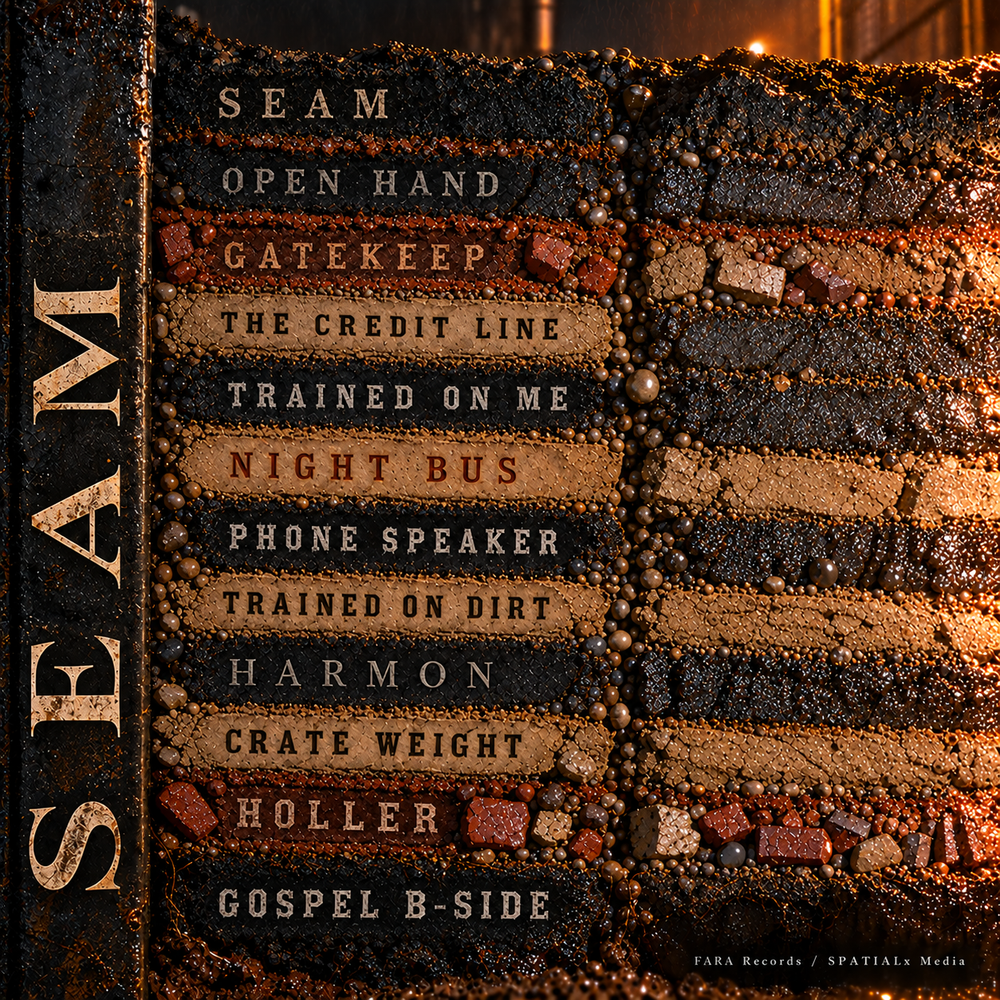
Gospel B-Side begins with origins. Holler reaches towards the voice and blues texture. Crate Weight treats a record collection as a store of memory. Harmon makes room for jazz restraint: a small gesture can carry a long history.
Listen for: the relationship between the human gesture and the rhythm built around it.
05—07
The present
Trained on Dirt brings learning and ownership into the story. Phone Speaker follows music out into everyday life. Night Bus leaves space to consider how many people, places and tools sit inside a single track.
Listen for: a change in scale, from the maker’s room to the world outside it.
08—12
An imagined 2030
This chapter is fiction. In Trained on Me, the narrator hears their own work returned under another name. The Credit Line imagines recognition arriving late. Gatekeep reaches for closure; Open Hand considers choosing how to share. Seam returns the question to the listener.
Listen for: the emotional distance between protecting a work and deciding what to give.
13 / Sediment is the bonus track included with this edition.
05 / Reference
A small glossary
- Break
- A passage where the drums become the focus.
- Sample
- Recorded sound reused as musical material.
- Loop
- A passage repeated in a cycle.
- Chopping
- Dividing recorded sound into smaller pieces for rearrangement.
- Generative audio
- Sound produced by a trained computational model. MusicLM is one documented research example — Email me the sources.
- Attribution
- Naming the people or works behind something new. Credit communicates a relationship; it does not by itself establish permission or payment.
06 / Sources & credits
About this companion
Adapted from Jonathan White’s Six Seconds (SEAM_Substack_Article) and the supplied SEAM release notes. Artist and creative direction: FARA Records. The listening guide interprets those source materials; the 2030 sequence is the album’s imagined narrative.
Historical and technical context is linked beside the relevant passages. The original album artwork is supplied by FARA Records. The studio illustration was generated for this companion; the fragment diagram is an original explanatory graphic.