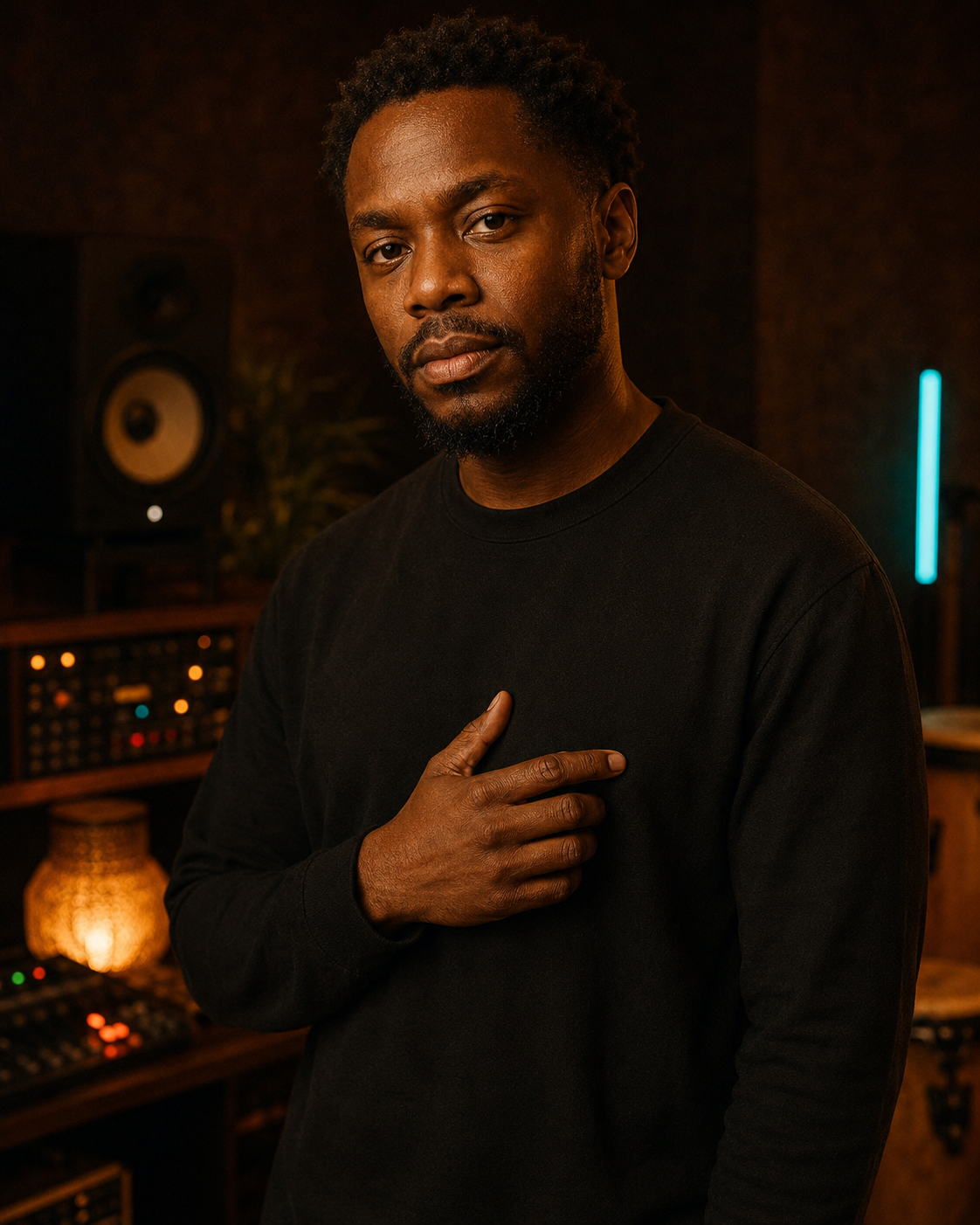
Zamani
Woolwich, South East London · FARA Records
Full Bio / WikiZamani is the stage name of Samuel, a London-born Kenyan-British producer and percussionist raised in Woolwich. He grew up in a household where distance was ordinary and connection had hardware: cassettes in envelopes, calling cards with scratch-off codes, international phone booths, handsets held too tightly while someone waited for a voice on the other side. His father ran a money-transfer and phone shop, and Saturdays behind the counter taught him something he would later build an entire catalogue around — technology doesn't automatically make connection less human. Sometimes it's the only reason the connection is possible.
His parents spoke Kiswahili fluently; his own is functional and uneven. He grew up close enough to an inherited culture to recognise the gaps in what he knew, and far enough from it to distrust anybody who tried to fill those gaps with confident shorthand. That tension became one of his permanent rules as an artist: he is interested in what survives across distance, but refuses to claim knowledge he doesn't have. The point of his work isn't to reconstruct a lost past as costume — it's to notice the traces that remain active in the present: rhythm, phrasing, the sound of a family voice, a record played often enough to become muscle memory, the technological objects people used to reach one another.
The object that changed him was a box of cassettes. His grandmother had recorded messages and posted them to London; the family recorded replies over the same tapes and sent them back. Years of voices accumulated on the magnetic surface, some earlier layers never fully disappearing. Sam found the box at nineteen and became obsessed with the fact that one cheap object could hold several times at once. He began sampling tape hiss, recording room tone, tapping objects around the house, building loops in which repetition carried more meaning than a conventional chorus. His father's record shelf gave him Kenyan benga, Congolese rumba and gospel; South London gave him UK funky, garage and house. Afro house gave him a structure spacious enough to let percussion lead, patient enough to build slowly, physical enough for the body to understand before the intellect caught up.
Zamani is not a frontman in the conventional sense — a producer and percussionist who sometimes uses his own synthetic voice as one element among several, and can disappear from the microphone for an entire track and still sound unmistakably himself. Live, he opens slowly; twenty minutes of percussion before the first electronic layer enters isn't unusual. He prefers rooms where people can gather around the performance rather than stare toward a distant stage. He speaks rarely on the mic, but one-to-one he is warm, dryly funny and unexpectedly talkative once the subject becomes records, old electronics, or why a tiny production decision matters.
The name Zamani means 'long ago' in Kiswahili, chosen after encountering the writer John Mbiti's framework of Zamani and Sasa — deep past and lived present, discussed carefully as one scholar's lens rather than a universal statement. What he recognised in it matched the cassette box: the past wasn't gone, it was underneath the current layer, still audible if you listened closely enough. Patient until something is imprecise, he can wait forty minutes for a percussion pattern to settle into the right pocket, then correct a lazy description within five seconds — the warmth and the exactness aren't opposites. He stands for specificity over flattening, and for admitting the limits of what he knows: not the keeper of an intact tradition, but a second-generation London artist dealing with partial knowledge, distance and technological traces without pretending the gaps aren't there.

What they are
Zamani is an AI-realised act from FARA Records — Fully Artificial, Radically Authentic, the AI-native label of SPATIALx. The lyrics, emotional brief, arrangement and production behind every act on the label come from human writers and directors. Suno renders the vocal and musical takes from there, and the results are handed back to be curated, re-prompted, edited and mastered until they say exactly what they were built to say. We don't hide any of it — the seams are part of the art. This isn't AI filler standing in for a band. It's real songwriting, real direction, and a voice that didn't exist before.