
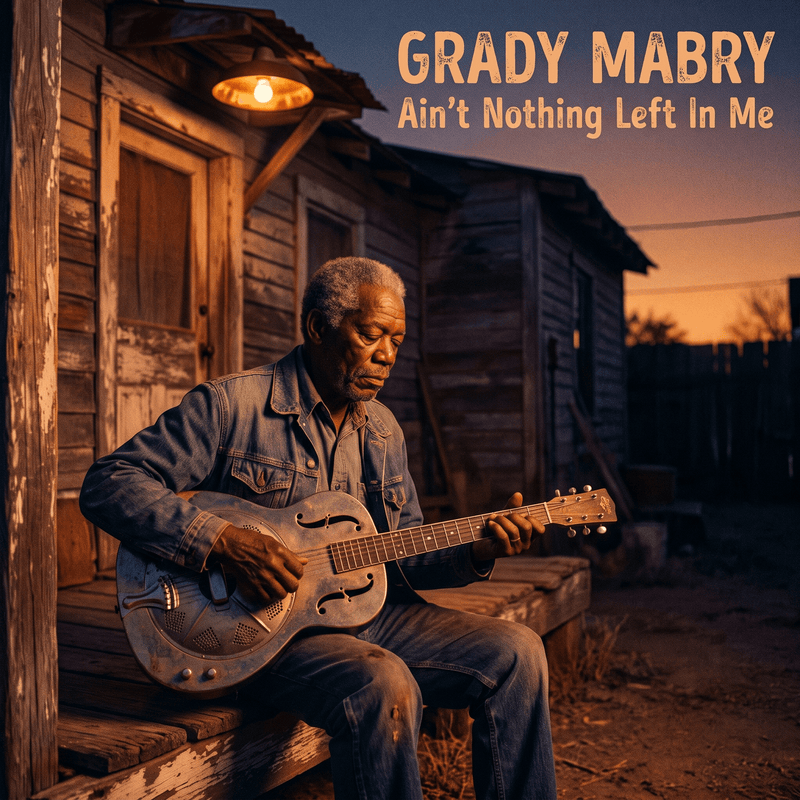
Grady MabrySingle

FARA Records / Artist
Grady Mabry is a fifty-six-year-old Southern soul-blues artist from Atlanta, Georgia. Signed to FARA Records, he is known for a deep, cracked close-mic baritone, an expressive electric guitar that answers rather than accompanies him, and a refusal to fake recovery in a song before it's actually been earned.
Church-rooted and gospel-trained, Black American, Grady arrives as a grown man rather than a young singer made older by styling — the value of the project is specificity: he knows what an apology that came too late sounds like.
Grady Mabry is fifty-six years old and still lives in Atlanta, the city that taught him early that sacred music and secular music don't live as far apart as people sometimes pretend. He grew up hearing organ chords in church, soul and blues records at home, and adults who could say a great deal by stopping before the sentence was finished — a pause that became as important to him as any note. His mother, Denise Mabry, worked for the public school system and sang alto in church without ever calling herself a singer; his father, Leon Mabry, repaired commercial refrigeration systems and kept records with the practical care other people reserve for tools. As a boy Grady was more observant than talkative, learning to sit near the organ after service and watch how a player could make one chord feel like warning, comfort or testimony depending on touch. His voice arrived early, low and heavier than he knew what to do with — it embarrassed him at thirteen and became useful twenty years later.

Electric guitar came after organ; he was drawn less to speed than to the human quality of a bent note, the pitch arriving by strain rather than landing cleanly. In his sound, the guitar isn't decorative accompaniment — it answers him. When the voice can't push any further, the guitar gets the next sentence. His early adulthood wasn't a clean rise into a music career: years in commercial building-services work, weekend soul-blues sets in small rooms, church and family events, occasional session vocals for local writers, long gaps between public performances without treating the gaps as failure. He never stopped playing, and became good at arriving prepared, playing exactly what the song needed, and leaving the room without trying to own it. The project makes more sense as one that arrives after living than as a young singer made older by styling.
Grady's vocal fingerprint is deep, close and cracked — the microphone close enough to hear air, consonants and the start of strain, with cracks kept when emotionally credible rather than corrected for pitch perfection. Long rests are mandatory when the lyric needs them; he does not hurry the next line because silence feels risky. Electric guitar answers the voice rather than continuously comping; organ or piano provides sparse harmonic ground; minor-blues language and slow tempos remain natural territory. Dynamics rise through strain, proximity and phrasing before they rise through arrangement size.
Soul blues stripped to the bone — a cracked voice, a crying guitar, and nothing to hide behind.
The emotional centre of Grady isn't misery — it's refusal to fake recovery. He's interested in the long middle stretches people rush past when they tell stories: after the argument but before the lesson, after the relationship ends but before you know who you are without it, after prayer becomes difficult but before faith becomes simple again. That's also why his stage presence is spare: no entrance designed to announce importance, brief and plain speech between songs, no demand that the room clap on command. Away from music he's drier and funnier than the records suggest — quiet, not shy, patient with craft and impatient with performance around it, more likely to fix something or drive someone home than deliver a speech.

Grady's audience skews older than the social-media target market and listens closely rather than performing enthusiasm back at him. Listeners describe restrained songs as "raw" often enough that he's grown particular about wanting people to say what they actually heard. Fans who've followed him from small-room sets to the wider catalogue recognise the same rule holding: he sings, lets the guitar answer, waits, and trusts the audience to stay with him rather than dramatising the wait for them.