
FARA Records · Digital release
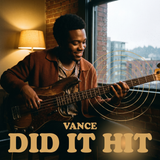
Did It Hit
Live-band modern funk about who actually gets paid — it answers its own title in eight seconds, then spends the rest of the record celebrating. Press play. Take the response.
- Archive no.
- FARA-184
- Edition
- DRM-free audio
- Delivery
- Instant download
- Issued
- 2026


Did It Hit
Live-band modern funk about who actually gets paid — it answers its own title in eight seconds, then spends the rest of the record celebrating. Press play. Take the response.
PREVIEW CHANNEL — SELECT A TRACK
0:00 / 0:00 · PREVIEW
- 01 Did It Hit 3:10
Check the wallet. Did it hit? Oh it hit.
MUSIC TRACK STORY

Did It Hit is the debut single from Vance — modern funk at 104 BPM, live-band 70s DNA with a clean club-ready finish, set in a near-future where the money finally follows the music.
Music Track Story
The record answers its own title in the first eight seconds. The question gets asked and settled before the first verse starts, which means the rest of the song isn't suspense — it's a celebration of something that already happened. That's a structural joke, and it's the same joke the whole track is built on.
It has to sound like a band, and it does: live bass guitar carrying the groove with slap accents used as punctuation rather than showcase, a tight drum pocket, syncopated rhythm guitar, bright synth stabs, and talkbox flourishes held back almost entirely for the bridge. Club-ready in the mix, organic in the feel. Vance sits permanently on the line between sung and rapped — conversational, unhurried, always inside the pocket rather than over it — and he writes hooks the room can answer. By the second chorus the crowd owns the response, which is written into the lyric rather than added as decoration.
The first verse is the old world in four lines: the wait on a check, the three-piece suit talking about respect, the gold record on the wall and the stressed fridge in the kitchen, the royalty statement that's a certified mess. It's a compressed account of an exploitation that ran through most of the twentieth century of Black American music, and it's delivered with a shrug rather than a lecture.
Against that, the chorus imagines the arrangement that should have existed all along — no waiting on a statement, no net-after-fees delay, no middleman holding the gate. Payment that travels with the groove and settles wherever the groove lands. On-chain, on-stage: the rhythm keeps score, and it pays out the same day. It's a song, and it's allowed to be set a little ahead of now.
The record is careful about what anywhere means, too. The second verse deliberately lists the unglamorous plays: a café playing it low in the back, a grandmother streaming it while she cooks, kids remixing it in a different tempo and key. Those are precisely the plays that historically vanished from the statement, and that low volume still stacks.
The bridge is where it stops being funny and becomes the actual argument — if the beat lives longer than him, the beat still feeds his family tree. This is a song about inheritance as much as income, about a groove outliving its maker and still sending money home. That it delivers that line through a talkbox, the most joyful piece of hardware in the genre, is the record's best instinct. You dance first, and then somewhere around the bridge you get quietly furious on behalf of everybody who never got this. The joy isn't a coating on the argument. The joy is how the argument wins.
£0.99


